 App Developer

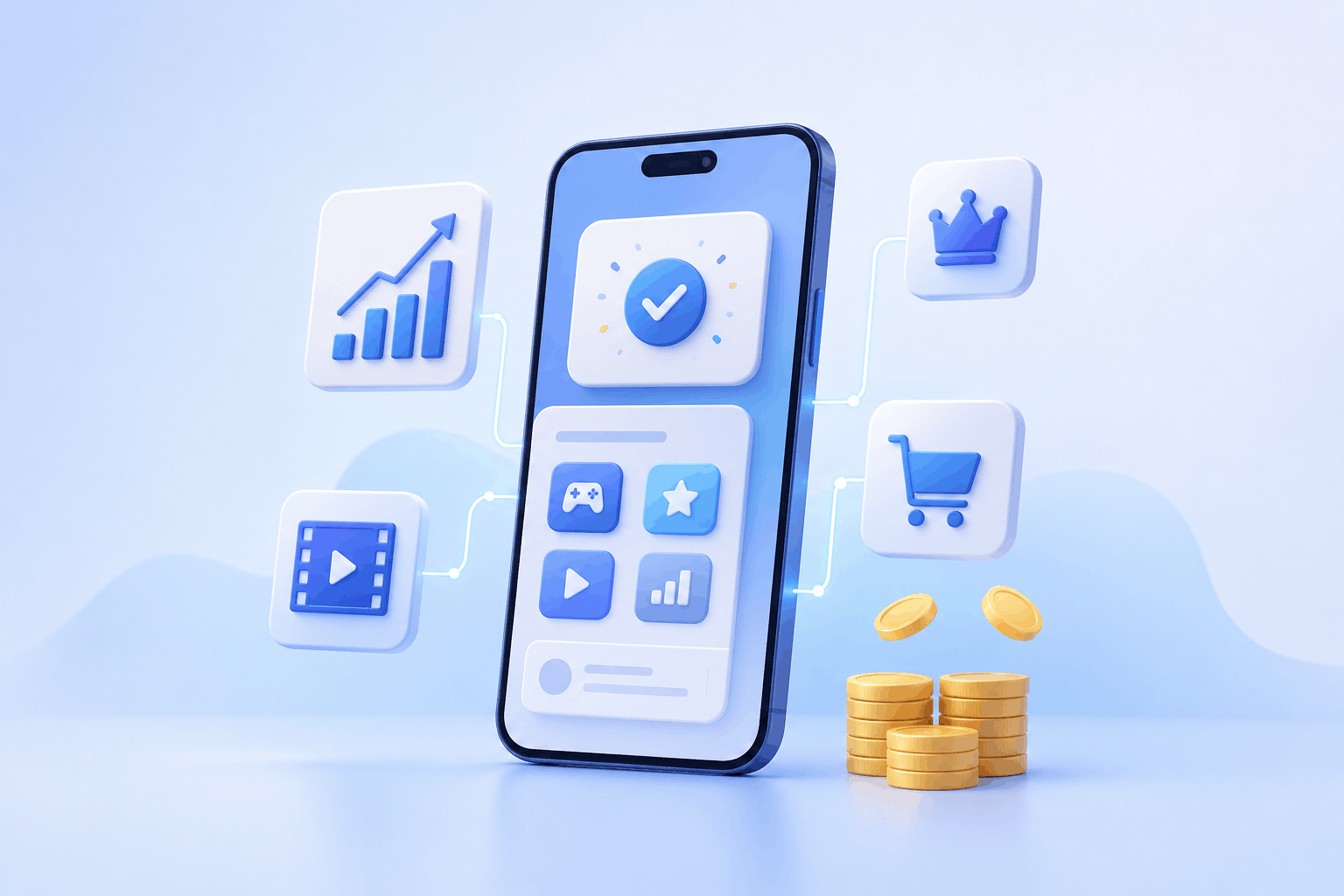
How do apps make money? In most cases, apps make money by giving people something genuinely useful for free, then charging for the optional upgrades, features, or access that a smaller group of committed users are happy to pay for. The app is free to download, but the business behind it earns revenue through subscriptions, in-app purchases, a freemium model, advertising, or a blend of all three. Understanding how apps make money is the difference between building a product people love and building a product that also pays for itself.
The old assumption was simple: if you want to earn revenue, put a price tag on the download. That model is mostly dead. Today the highest-grossing apps on the App Store and Google Play are free to install, and they make money after the download, not before it. This guide breaks down exactly how apps make money in 2026, which monetization strategies work best for which categories, and how to design revenue into your product from day one instead of bolting it on later.
How do apps make money without ads?
Plenty of founders assume advertising is the only way a free app can earn revenue. It is not. Apps make money without ads by delivering real value first and then charging for a premium layer that a portion of users genuinely want. When people can try the core experience with no risk and no upfront payment, they are far more likely to convert into paying customers later — and that conversion, not an ad impression, is where the durable revenue lives.
Ad-free monetization usually leans on subscriptions, in-app purchases, and freemium upgrades. These models tie revenue directly to the value a user receives, which tends to produce higher lifetime value and a cleaner experience than filling the screen with banners. Ads still have a place, especially for high-traffic apps with casual users, but they are one option among many — not the default answer to how apps make money.
Is a free app profitable?
Yes — a free app can be extremely profitable, but profitability comes from how you design monetization, not from the price of the download. A free app makes money when it separates a free tier that delivers immediate value from a premium tier that solves a stronger, ongoing problem. Get that separation right and free users become a marketing engine while premium users pay the bills.
In practice, the most profitable free apps share a few traits. The core experience delivers clear value within the first session. The premium features solve a problem that gets more painful the more someone uses the app. Monetization appears only after the user has felt the value, never before. And the app attracts high-intent users — people whose reason for downloading is closely tied to something they would pay to do better.
- The core experience delivers immediate, obvious value in the first session
- Premium features solve a stronger, recurring problem than the free tier
- The paywall or upgrade prompt appears after users experience real value
- The app attracts high-intent users who are already willing to pay
- Retention is strong enough that subscriptions and repeat purchases compound over time
If any of those pieces is missing, revenue tends to stall no matter how many downloads the app collects. Millions of installs mean nothing if the product never gives users a reason to pay. That is why the smartest teams treat monetization as a product-design question, not a pricing question — and why the same free app can either lose money or print it depending on how carefully those decisions are made.
Free vs. paid apps: which model makes more money?
It is natural to assume that charging for a download is the safer path to income, but the data says otherwise. Free-to-download apps generate the overwhelming majority of app-store spending, because a free install removes the biggest barrier to trying a product. Paid apps still work in narrow niches — professional tools with a clear, immediate payoff — but they cap their own audience at the small group willing to pay before they have experienced anything at all.
A free app trades an upfront fee for reach. More installs mean a larger pool of people who can eventually upgrade, subscribe, or buy, and a bigger audience to learn from. For the vast majority of products in 2026, a free download paired with a strong premium offer will out-earn the same app hidden behind a store-page price tag. The real question is rarely free versus paid — it is which post-install model best fits the value you deliver and how often people come back for it.
How do apps make money? 10 monetization strategies that actually work
There is no single answer to how apps make money — the best-performing apps combine several revenue streams. Below are the ten monetization strategies that generate the vast majority of app revenue today, when each one works best, and the trade-offs to watch for. Most successful apps use two or three of these together rather than betting everything on a single model.
1. In-app purchases: turning free users into paying customers
In-app purchases (IAP) let users buy specific items or unlocks inside an otherwise free app. They come in three flavors: consumables that are used up and bought again (coins, credits, extra lives), non-consumables bought once and kept forever (a pro unlock, a removed watermark), and unlockable content like new levels, templates, or tools. In-app purchases are the backbone of how apps make money in gaming, and they work just as well for creative and utility apps.
In-app purchases perform best where there is a repeatable use case and a natural moment to spend. A photo editor selling filter packs, a game selling power-ups, or a language app selling extra lessons all give users a reason to make a purchase exactly when their motivation is highest. The key is to sell things that feel like an upgrade to an experience users already enjoy, not a tax on using the app at all.
2. Subscriptions: how apps earn predictable recurring revenue
Subscriptions are how apps make money on a recurring basis — users pay a weekly, monthly, or yearly fee for ongoing access to premium features, content, or services. Because the revenue repeats, subscriptions produce the most predictable and highest lifetime value of any model, which is why they now dominate the top-grossing charts across nearly every category from streaming to productivity.
Subscriptions work best for apps that deliver ongoing value: productivity and professional tools, health and fitness, finance, learning, and anything people return to week after week. The trick is to make the recurring value obvious. A subscription only survives if users feel they are getting more out of the app each month than they are paying for it, so the premium tier has to keep earning its place with fresh value.
3. Freemium models: free value that converts power users
The freemium model combines a genuinely useful free tier with a paid tier that unlocks advanced features. The free tier exists to attract users and prove value at scale; the premium tier exists to monetize the smaller group of power users who hit the limits of what free offers. Done well, freemium is one of the most efficient ways apps make money, because the free product doubles as the marketing.
Freemium performs best when a large portion of users can be genuinely satisfied with the free tier while a meaningful minority need more — more storage, more projects, more automation, more control. If the free tier is too generous, nobody upgrades to premium; if it is too limited, nobody sticks around long enough to become a paying customer. Finding that line is the core craft of freemium monetization.
4. Paywall optimization: pricing, trials, and conversion
A paywall is the screen that asks a user to pay, and its design has an outsized effect on revenue. Two apps with identical features can see wildly different conversion rates based purely on when the paywall appears, how the pricing is framed, and whether a free trial is offered. Paywall optimization is often the fastest way to increase revenue without changing the product at all.
Paywalls perform best when they appear after users experience value, not before. Show the paywall too early and it feels like a toll booth; show it right after a user completes something meaningful and it feels like a natural next step. Testing price points, annual-versus-monthly framing, and trial length is one of the highest-leverage things a team can do, because small conversion gains compound across every future paying customer.
5. Affiliate marketing and referral revenue
Affiliate marketing lets an app earn a commission by recommending third-party products or services. When a user taps a link and buys something, the app takes a cut. This is how apps make money when they naturally sit near a purchase decision — a travel app suggesting hotels, a fitness app recommending gear, or a finance app comparing cards and accounts.
Referral revenue works best when the recommendation genuinely helps users rather than interrupting them. If the affiliate offer fits the moment — the right product at the right time — it can add a meaningful revenue stream without any of the cost of building and shipping physical goods. The risk is trust: push low-quality offers and you erode the relationship that makes users open the app in the first place.
6. Sponsorships, partnerships, and brand deals
Instead of running programmatic ads, some apps make money through direct sponsorships and brand partnerships. A brand pays to reach the app's audience through featured placements, sponsored content, co-marketing, or bundled offers. This works far better than banner advertising for apps with a clear, valuable niche audience that brands specifically want to reach.
Sponsorships reward focus. An app with a tightly defined community — runners, indie musicians, or small-business owners — can command premium sponsorship rates because the audience is exactly who a partner wants. The revenue is less automated than ads, but it protects the user experience and often pays far more per user, which is why niche apps lean on it as a core revenue stream.
7. Selling digital or physical goods inside apps
Many apps make money by selling goods directly — digital products like templates, presets, and courses, or physical products shipped to the user. Commerce apps are the obvious example, but plenty of content and community apps add a store once they have an engaged audience. Selling goods turns attention into revenue without depending on subscriptions or ads at all.
Physical and digital commerce is a huge share of the total app economy. Apple's 2025 report noted that physical goods and services sold through apps accounted for over a trillion dollars in App Store ecosystem billings — the large majority of the total. That scale is a reminder that "how do apps make money" often has a very direct answer: they sell people things those people actually want to buy.
8. Data monetization: earning from aggregated insights
Some apps make money by building separate data products from aggregated, anonymized usage insights. Market researchers, retailers, and analysts will pay for trend data that a large user base generates as a byproduct of normal activity. Done responsibly, this can help fund an app that stays entirely free for the users who power it.
The line to walk here is trust and regulation. Users are far more aware of how their data is used than they were a few years ago, and privacy laws now have real teeth. Apps that monetize data successfully are transparent about it, give users clear control, and never treat personal information as a resource to be quietly sold. Cross that line and the short-term revenue is never worth the long-term damage to the brand.
9. Licensing and white-labeling app technology
If the real value of an app is its underlying technology, licensing and white-labeling can be a powerful way to make money. Instead of only selling to end users, the company licenses its engine, SDK, or platform to other businesses, or offers a rebranded version that other companies ship under their own name. One strong piece of technology can then earn revenue across dozens of partners at once.
White-labeling works especially well in B2B, where a proven solution is worth far more to a business than building the same thing from scratch. The trade-off is that you now serve partners as well as users, which reshapes support, roadmap, and pricing. But for the right product, licensing turns a single app into a whole revenue platform with margins that pure consumer monetization struggles to match.
10. Hybrid monetization: how top-grossing apps combine models
Here is the honest answer to how apps make money at the top of the charts: they rarely rely on one model. The highest-grossing apps blend subscriptions with in-app purchases, add a freemium tier, and sometimes layer in commerce or ads for the users who never upgrade. Hybrid monetization captures value from every type of user instead of leaving money on the table.
A hybrid approach might offer a free tier supported by light advertising, a subscription for committed users, and in-app purchases for one-off needs. Each user pays in the way that suits them — with attention, with a recurring fee, or with occasional purchases. The result is a revenue base that is both larger and more resilient than any single stream could produce, which is exactly why hybrid monetization has become the norm rather than the exception.
How to choose the right monetization model for your app
With ten strategies on the table, picking the right one can feel overwhelming. In practice, the decision comes down to three questions: how often do people use the app, how strong is the ongoing problem it solves, and how naturally does a purchase moment fit inside the experience? Answer those honestly and the right monetization model usually becomes obvious.
- High-frequency, ongoing value (fitness, productivity, learning) → subscriptions
- Repeatable, in-the-moment spending (games, creative tools) → in-app purchases
- Broad free tier with a smaller group of power users → freemium
- A clear purchase decision nearby (travel, finance, shopping) → affiliate or commerce
- A tightly defined, valuable audience → sponsorships and partnerships
- Proven technology other businesses want → licensing and white-labeling
Most teams do not need to choose just one. A useful starting point is to launch with the single model that best matches your core use case, prove that users will pay for it, and only then layer in a second or third stream. Trying to monetize five ways on day one usually confuses users and slows the product down; trying to monetize one way for years usually leaves revenue on the table that a hybrid approach would have captured.
The key metrics behind how apps make money
Whichever model you choose, the same handful of metrics determine whether an app actually makes money at scale. Tracking them turns monetization from a guess into a system you can measure and improve week over week.
- Conversion rate — the share of users who move from free to paying
- Average revenue per user (ARPU) — total revenue divided by active users
- Average revenue per paying user (ARPPU) — revenue divided by paying users only
- Churn rate — how many subscribers cancel or lapse each month
- Lifetime value (LTV) — total revenue a user generates over their time in the app
- Customer acquisition cost (CAC) — what it costs to acquire each paying user
The relationship between LTV and CAC is the single most important number in app monetization. If it costs more to acquire a user than that user will ever pay back, no amount of downloads will make the app profitable — growth just accelerates the losses. When LTV comfortably exceeds CAC, though, every dollar spent on acquisition returns more than a dollar in revenue, and scaling user acquisition becomes one of the safest investments a team can make.
Common mistakes that stop apps from making money
Most apps that fail to monetize are not failing because the model was wrong — they are failing because of a handful of avoidable mistakes in how that model was implemented. Recognizing these early can save months of lost revenue.
- Showing the paywall before users have felt any real value
- Making the free tier so generous that almost nobody needs to upgrade
- Making the free tier so limited that nobody sticks around long enough to convert
- Pricing based on gut feeling instead of testing against comparable apps
- Ignoring churn until it quietly erases new subscriber growth
- Adding a second monetization model before the first one is proven
Each of these mistakes is fixable, and none of them require rebuilding the app from scratch. Most come down to sequencing: show value, then ask for payment; prove one revenue stream, then add another; measure churn as closely as new sign-ups. Teams that treat monetization as an ongoing practice — not a one-time setup — consistently out-earn teams that set a price once and never revisit it.
How long does it take for an app to start making money?
There is no universal timeline, but a realistic pattern shows up again and again. In the first one to three months after launch, the priority is proving that people use the app and come back — revenue at this stage is usually small and that is fine, because the free experience is still being tuned. Between months three and six, teams that have validated retention start testing paywalls, pricing, and the first premium tier, and this is typically when meaningful revenue first appears.
From six months onward, the focus shifts to scaling what already converts: refining ASO so the right high-intent users find the app in search results, expanding the premium feature set, and reducing churn so subscription revenue compounds instead of leaking away. Apps that reach real, sustainable revenue in under a year almost always share one pattern — they nailed retention before they pushed hard on monetization, because no paywall can fix an app that people stop opening after the first week.
Why ASO matters as much as the monetization model itself
A free app can have the perfect subscription tier, the perfect paywall, and the perfect pricing — and still make very little money if it never reaches the people who would pay for it. App store optimization (ASO) is the discipline of making a free app easy to find for exactly the users who are most likely to convert, and it is one of the most underrated levers in how apps make money.
The keywords, screenshots, and store listing that bring in a casual browser are different from the ones that bring in a high-intent user already searching for a solution to a specific problem. Store listings built around terms like "premium," "pro," or a specific outcome tend to attract visitors who already expect to pay for the right features, which lifts conversion rates before a single in-app purchase or subscription screen is ever shown. Pairing strong ASO with a well-designed premium tier means every install arrives with a higher chance of turning into revenue, which is why the two disciplines have to be built together rather than treated as separate projects.
This is also where paid and organic user acquisition meet monetization directly. A free app that spends heavily to acquire users but ignores ASO is paying full price for traffic that better keyword targeting could have captured for free. Getting ASO right does not just grow downloads — it changes the mix of who downloads, and that shift in audience quality is often worth more than any single change to the paywall or pricing page.
How can App Developer help you build an app that makes money?
Knowing how apps make money is one thing; shipping an app that actually earns is another. At App Developer, we build monetization into products from the first line of code, so revenue is never something you try to retrofit after launch. Here is how we help teams turn a promising idea into an app that pays for itself.
1. Choose and validate the right monetization model
Not every app should be a subscription, and not every app should sell in-app purchases. We start by matching your product, audience, and category to the monetization strategy most likely to work — subscriptions, freemium, in-app purchases, commerce, or a hybrid — and validate that choice against how comparable apps make money before we build. Picking the right model early saves months of expensive rework later.
2. Build a premium experience users actually pay for
Revenue lives in the gap between free and premium. We design that gap deliberately: a free tier that delivers immediate value and a premium tier worth paying for, with paywalls and upgrade prompts placed exactly where users feel the most value. Clean iOS and Android architecture means new premium features, subscriptions, and in-app purchases can ship fast as your product grows.
3. Improve conversions and retention
Making money from an app is a conversion problem as much as a product one. We optimize onboarding, paywall timing, pricing presentation, and free-trial flows so more users become paying customers — and we build the retention features that keep subscriptions alive month after month. Small gains in conversion and retention compound into a much larger revenue base over time.
4. Connect acquisition, engagement, and revenue
An app only makes money with a steady flow of the right users. We help connect user acquisition — including ASO to attract high-intent users searching for exactly what you offer — with in-app analytics, so you can see which channels bring users who actually pay. When acquisition, engagement, and revenue are wired together, you can invest confidently in the growth that drives real revenue instead of guessing.
Frequently asked questions
How much money do apps make?
It varies enormously, but the ceiling is high. Apple reported that the App Store ecosystem generated well over a trillion dollars in billings and sales in 2024, and the large majority of that came from free-to-download apps rather than paid ones. A small indie app might earn a few hundred dollars a month, while a top-grossing subscription app can make millions — the difference comes down to the monetization model, retention, and the value delivered to users.
How do apps make money if they are free?
Free apps make money after the download, not before it. The most common models are subscriptions, in-app purchases, freemium upgrades, paywalls, advertising, affiliate and referral revenue, and selling digital or physical goods. Most free apps combine several of these so that casual users, committed users, and occasional buyers each contribute revenue in the way that suits them best.
How do you make money from an app as a beginner?
Start simple. Build a free core experience that delivers obvious value, add one clear premium upgrade — a subscription or a single in-app purchase — and place the paywall only after users have felt that value. Then focus on bringing in high-intent users through ASO and word of mouth. One well-designed upgrade path will make more money than a dozen half-finished ones.
Which types of apps make the most money?
Games lead on total in-app purchase revenue, while subscriptions dominate in productivity, health and fitness, finance, learning, and streaming. Commerce apps make money by selling goods directly and move enormous volume. Across every category, the apps that make the most money share one thing: a premium offering that solves a strong, ongoing problem for a high-intent audience.
The bottom line
So, how do apps make money? They give value first and charge for the upgrades that a committed group of users genuinely wants — through subscriptions, in-app purchases, freemium tiers, paywalls, commerce, and smart combinations of all of them. The download is free; the revenue comes from designing premium value that people are happy to pay for.
The apps that win are not the ones with the cleverest single trick. They are the ones that pair a clear monetization model with a steady flow of the right high-intent users and a product that keeps earning its place in someone's life. Get those three things working together, and "how do apps make money" stops being a question and becomes a system you can build, measure, and grow.